

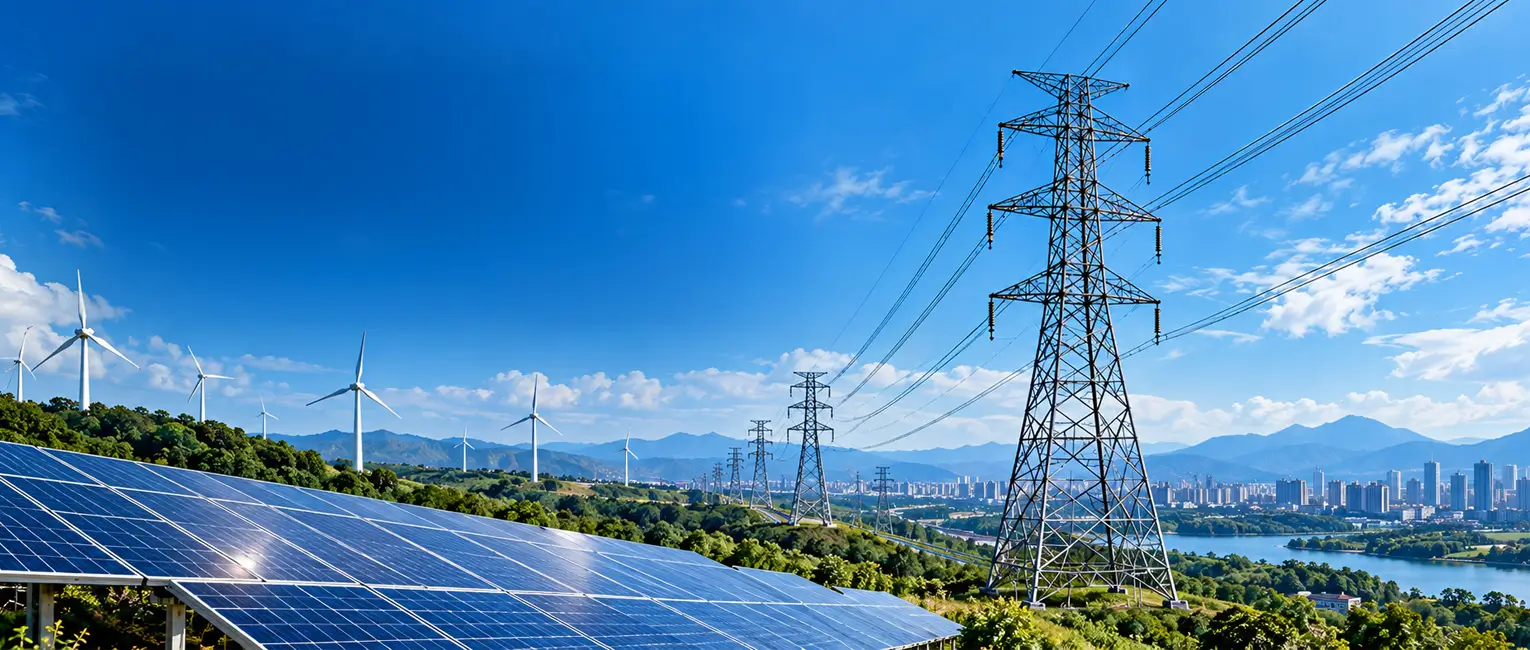
The world is adding solar and wind capacity at an unprecedented pace. Governments are announcing record-breaking renewable energy auctions, developers are racing to secure land and equipment, and investment continues to rise year after year.
Yet one critical part of the energy transition receives far less attention: generating clean power is only half the challenge. That electricity must still travel from where it is produced to homes, factories, businesses, and cities.
This is where transmission infrastructure becomes essential. And as renewable capacity expands rapidly, transmission networks are increasingly struggling to keep pace.
The scale of this challenge is already becoming clear. According to the International Energy Agency, at least 3,000 GW of renewable power projects worldwide are currently waiting in grid connection queues, around five times the solar and wind capacity added globally in 2022.
The generation capacity may be ready. The panels may be ready. The turbines may be ready. But without enough transmission lines, towers, substations, and supporting grid infrastructure, that power cannot reach the places where it is needed.
So, expanding renewable generation is only half the job. The other half—often overlooked—is building a transmission network strong enough, flexible enough, and extensive enough to carry that power reliably across regions and into the grid.
Why Transmission Cannot Be an Afterthought Anymore
For years, power transmission was often treated as infrastructure that could follow once generation capacity was in place. That model no longer works.
Solar and wind projects are frequently located far from major demand centres, in deserts, along coastlines, or on high-altitude plateaus. Getting that power to demand centres requires long transmission corridors to move power across regions. These networks can take years to plan, approve, and build, while renewable projects can often be developed much faster.
This growing mismatch is becoming one of the biggest constraints on the energy transition. In many markets, new renewable capacity is already being limited not by a lack of generation, but by the lack of grid infrastructure needed to carry that power.
Building Grids That Can Handle Renewable Energy
Renewable energy places very different demands on the grid. Unlike conventional power plants, solar and wind generation can change throughout the day, making the flow of electricity more variable and less predictable.
That means transmission infrastructure must do more than simply move power from one point to another. Towers, substations, conductors, insulators, clamps, and other line components all form part of a system that must manage changing loads, maintain voltage stability, and connect multiple renewable sources across long distances.
As renewable penetration increases, the strength and reliability of every part of the transmission network becomes more important. Even a small weakness in the system can lead to higher losses, faults, congestion, or curtailment—where available clean energy cannot be fully delivered because the grid is not equipped to carry it.
Interconnection Delays Are Now a Bigger Problem Than Generation
For renewable developers, one of the biggest challenges today is no longer building the solar or wind project itself—it is getting connected to the grid.
Across markets in the US, Europe, India, and parts of Africa, interconnection queues are becoming longer as grid infrastructure struggles to keep pace with new generation. Permissions and land acquisition remain important hurdles, but the physical buildout of transmission infrastructure is equally critical.
Transmission towers, transformers, substation structures, conductors, insulators, and other critical components all require time to engineer, manufacture, test, and commission before new capacity can flow reliably into the network. As renewable deployment accelerates through the rest of this decade, transmission will need to expand just as quickly—or the bottleneck will continue to move further downstream.
Vijay Transmission’s Role in Supporting Renewable-Ready Grids
At Vijay Transmission, this is largely the work we focus on, manufacturing end-to-end power transmission infrastructure, such as transmission towers, substation structures, and line accessories built for modern day demand of renewable-integrated grids. Whether it is a domestic project connecting a new solar park to the state grid, or an export order supporting rural electrification abroad, the requirement stays the same – infrastructure that performs reliably, project after project.
As more countries push toward ambitious renewable targets, the pressure on transmission networks will only keep growing. Meeting that demand means treating transmission not as a step that follows generation, but as a priority that moves at the same pace or maybe faster for now!
The Path Forward: Matching Grid Growth to Generation Growth
Solar panels and wind turbines get most of the attention. Towers, substations, and line hardware rarely do. Yet the next decade of the energy transition will be shaped as much by transmission capacity as by generation capacity. Countries and companies that treat grid infrastructure as a core part of the renewable energy story, and not a supporting act, are the ones that will actually deliver on their clean energy targets in time.